

 Image 1 of 1
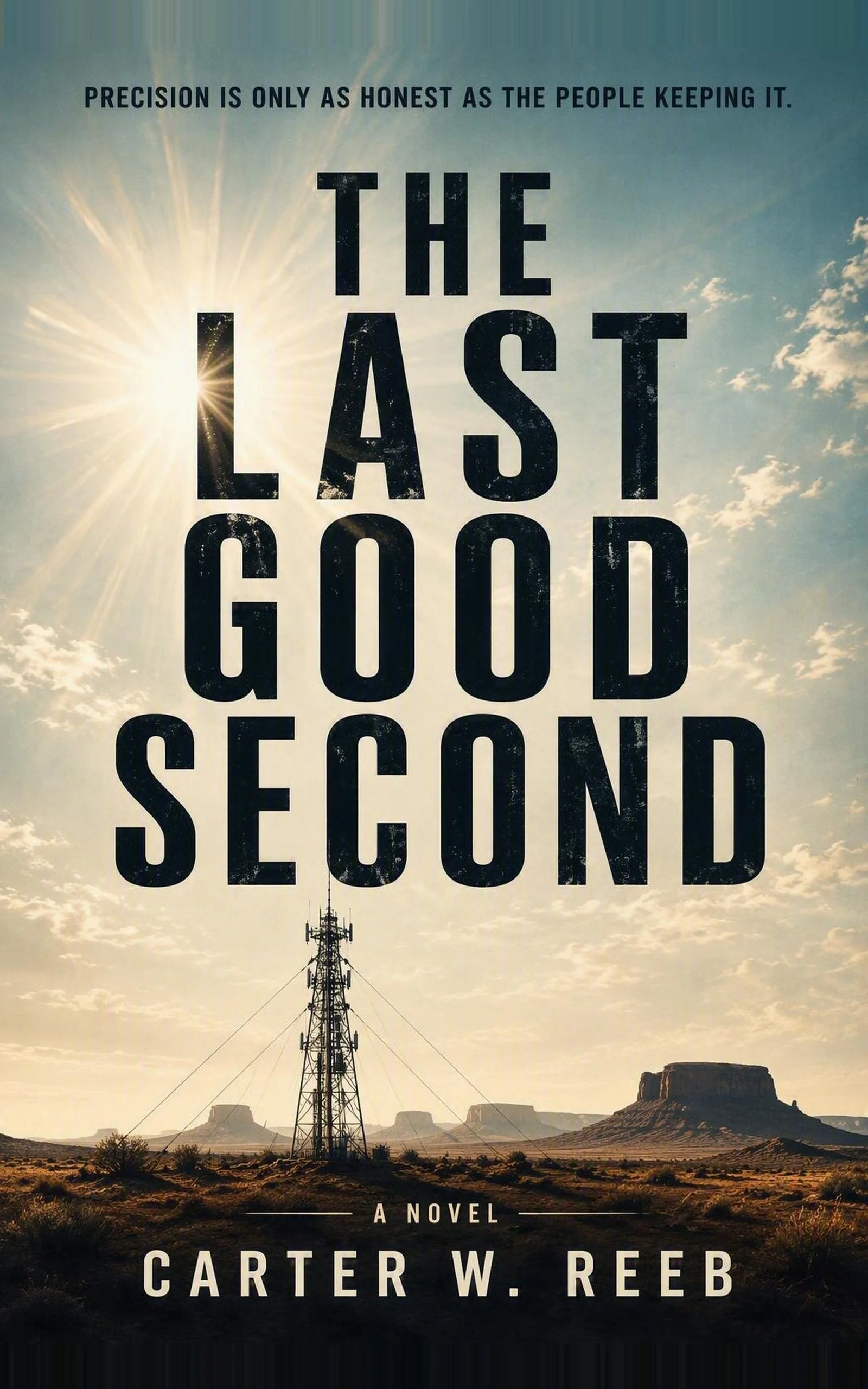
For one second, Dr. Elena Ortiz knows exactly what time it is. Then midnight arrives — without 23:59:59.
The world's first negative leap second was supposed to be a routine correction: delete one second and let civilization move on. Instead, networks skip, smear, repeat, or refuse the command. Banks freeze. Dispatch systems duplicate emergency calls. Defense computers preserve contradictory orders. By dawn, investigators have identified twelve digital histories of the same night. Every one is signed. Every one can prove where it came from. None can prove it is the history the world must accept.
Elena, a NIST timing scientist, is summoned to help choose. The evidence points to the fail-open protocol designed by Rafael Ortiz — the retired engineer she has barely spoken to in fourteen years. Her father.
Rafael insists the protocol didn't create the lie — it kept someone from erasing it. To test that claim, father and daughter race from the atomic-clock laboratories of Boulder to the radio fields of Fort Collins, following clues buried in the strange history of official time and in the night, thirty years earlier, when they waited together for Y2K.
What they uncover is larger than a failed clock correction and narrower than global chaos: inside the missing second, a human order to stand down crossed an automated authorization for a devastating military strike. Someone built twelve histories so the world would be forced to choose the one in which the machines were right.
Elena can reconstruct what physically happened. The harder question is whether truth is enough to make it official.
For readers of Andy Weir and Michael Crichton — a technothriller where the science is real, the stakes are global, and the clock is always ticking.
For one second, Dr. Elena Ortiz knows exactly what time it is. Then midnight arrives — without 23:59:59.
The world's first negative leap second was supposed to be a routine correction: delete one second and let civilization move on. Instead, networks skip, smear, repeat, or refuse the command. Banks freeze. Dispatch systems duplicate emergency calls. Defense computers preserve contradictory orders. By dawn, investigators have identified twelve digital histories of the same night. Every one is signed. Every one can prove where it came from. None can prove it is the history the world must accept.
Elena, a NIST timing scientist, is summoned to help choose. The evidence points to the fail-open protocol designed by Rafael Ortiz — the retired engineer she has barely spoken to in fourteen years. Her father.
Rafael insists the protocol didn't create the lie — it kept someone from erasing it. To test that claim, father and daughter race from the atomic-clock laboratories of Boulder to the radio fields of Fort Collins, following clues buried in the strange history of official time and in the night, thirty years earlier, when they waited together for Y2K.
What they uncover is larger than a failed clock correction and narrower than global chaos: inside the missing second, a human order to stand down crossed an automated authorization for a devastating military strike. Someone built twelve histories so the world would be forced to choose the one in which the machines were right.
Elena can reconstruct what physically happened. The harder question is whether truth is enough to make it official.
For readers of Andy Weir and Michael Crichton — a technothriller where the science is real, the stakes are global, and the clock is always ticking.